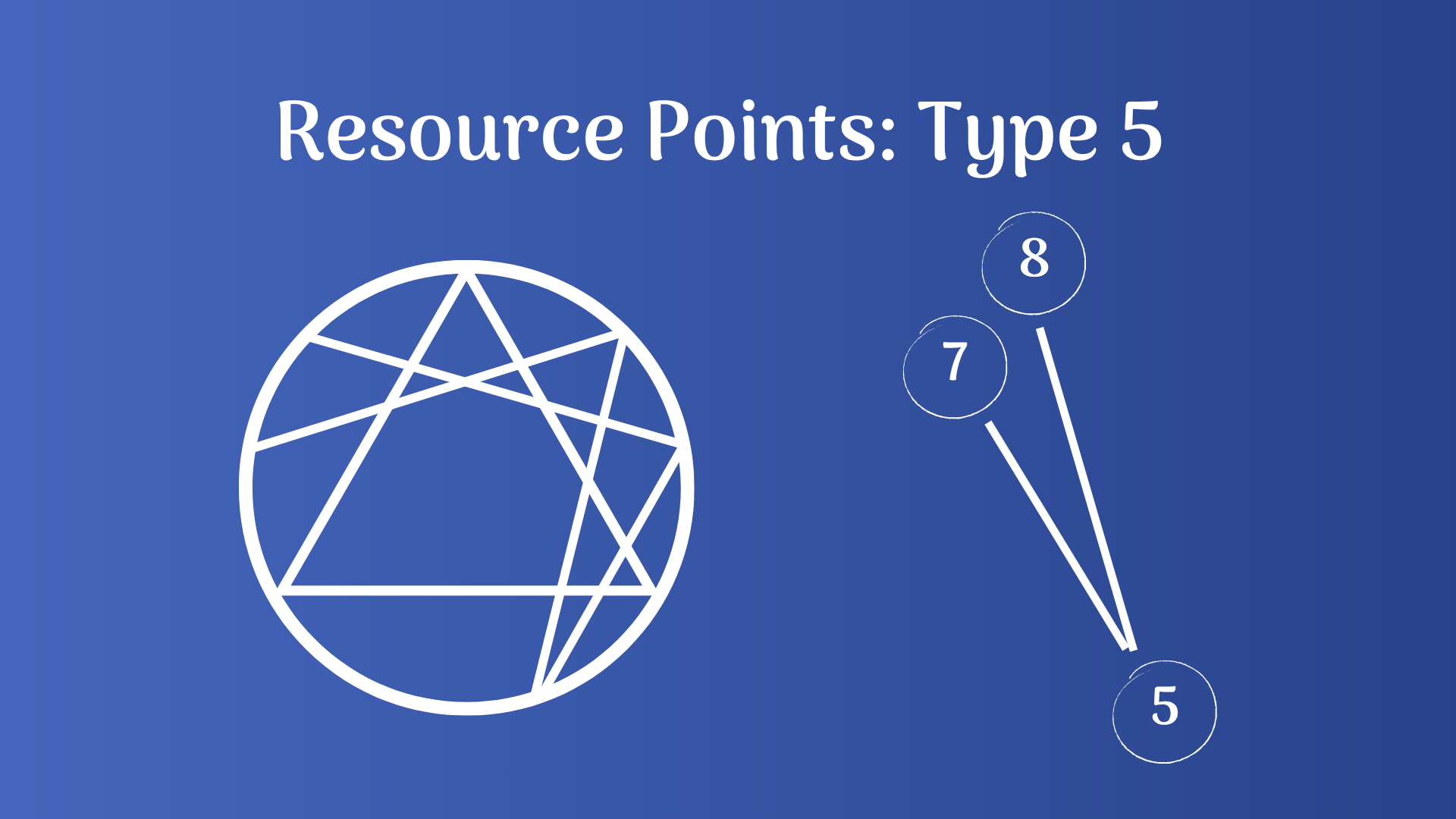
Welcome to the fifth post in our series on the Enneagram's connecting lines. So far, we've looked at the Resource Points for Types 1 through 4. Now we're moving on to Type 5. As a reminder, "Resource Points" is the language we're using because it moves us away from thinking of one line as the good one and the other as the bad one, and toward the idea that both territories hold answers to the problems of our home type.
To understand what 5s are drawing on when they move along their lines, it helps to first understand what's happening at home.
Type 5 and the Head Triad
As members of the Head Triad, 5s are concerned with security, safety, and certainty. They seek knowledge/expertise, which they believe will make them feel prepared to meet reality. They identify heavily with thoughts and ideas. 5s are passionately curious about subjects that "light a fire" in their minds.
What keeps 5s from fulfillment is the belief that they must be in a constant state of knowledge-acquisition. They tend to think that if they only knew more, they'd feel ready to make the move from observation into participation. But "knowing enough" becomes a moving goal-post.
In other words, the curiosity and expertise we see on the outside are tied to a feeling of readiness that never quite arrives on the inside.
Movement Along the Lines: Allowing That You Know Enough
For 5s, movement along the lines is about allowing the supposition that they know enough already. They can fail to see that expertise is meaningless if it doesn't get used to create meaningful action.
When 5s can risk moving into action without needing to feel 250% sure of their knowledge set, they find that they're quite capable. They set a high bar for themselves, and are often shocked to find others still perceive them as wise even when they don't feel "fully studied up." They need to realize that their natural perceptivity is more powerful than piles of research.
This becomes possible when 5s access their Resource Points.
Making Conscious Movement
As we discussed in the intro, what makes the lines useful is conscious movement, rather than something that just happens to us. For 5s, the way to achieve conscious movement along the inner lines is to be awake to one's own patterns, and to observe when automatic habit takes over.
Through self-observation, 5s learn to "repeatedly unhook their attention" from potential intrusions and the demands of the outside world. That word repeatedly matters. The attention gets hooked again and again, and the practice is to keep noticing it and unhooking it, each time it happens.
When they are awake to themselves and present in the moment, they get the best of their Resource Points.
Point 7
Here, 5s find the ability to go "broad" as well as "deep" with their interests. Free-associative thinking opens up, adding power to their "mental categorizing and filing" abilities.
Remember that 5s are passionately curious, and that their curiosity tends to run deep. Point 7 is where it can run wide, too. When 5s draw on their resources at point 7, they can widen out their perspective for a birds-eye-view, enjoying a variety of topics/subjects. Their powers of objective observation take on an edge of excitement and wonder.
Point 8
Here, 5s move from a state of contractedness to a state of expansiveness. Instincts come online to balance out thinking, and fear of depletion is substantially lessened.
Remember that 5s identify heavily with thoughts and ideas, and that they're seeking to feel prepared to meet reality. Point 8 is where that readiness stops being a thing to acquire. Drawing on their resources at point 8, 5s come into their personal power. They don't need to "hide in the safety of their minds," for fear that the world will deplete them, because they feel capable, empowered, and ready to meet reality.
When Wonder and Power Get Complicated
Generally speaking, point 8 is the growth point for 5s, and tends to light up when they're feeling expansive. Point 7 is the stress point, and tends to light up when they're feeling contracted. But because each Resource Point holds a full range, neither one is automatically a smooth ride (or automatically a rough one). Remember, we're not sorting these into "good" and "bad."
At point 7, the broad, free-associative thinking can show up in less conscious ways. Going "broad" can turn into scattered, restless hopping from topic to topic, which is really just the home type's knowledge-acquisition on a faster track. Or the excitement and wonder can become a way of staying up in the mind, rather than a way of connecting with what's in front of them. When 5s are awake and present, though, point 7 is what we described above: a birds-eye-view, and an edge of excitement and wonder in their objective observation.
At point 8, the expansiveness can go sideways too. After so much time spent in contractedness, the instincts can come online with more force than anyone expected, and personal power can show up as bluntness or intensity, rather than a steady sense of being capable. Or the discomfort of all that expansiveness can send 5s right back to "hiding in the safety of their minds." With conscious movement, point 8 is where 5s come into their personal power, and feel ready to meet reality.
This is exactly why conscious movement matters so much. Both points hold the full range, and self-observation is what helps 5s draw on the healthier end of each.
Wonder and Power: Two Resources, One Pattern
Taken together, the two Resource Points address the two sides of the pattern we started with. Point 7 offers breadth, free association, and a sense of excitement and wonder to go along with all that depth. Point 8 offers instincts that balance out thinking, and a sense of personal power that lessens the fear of depletion. Neither asks a 5 to stop being curious, and neither is a "reward" or a "punishment." They're two territories where 5s can find what their home type has a hard time granting itself.
Questions to Sit With
If you're a 5, or you love one, here are a few questions drawn from everything above:
Do I already know enough to take the next step?
What would it be like to let my perceptivity speak, without a pile of research behind it?
What is my body telling me right now, and what do my instincts say?
The Takeaway for Type 5
It's possible to be wise, perceptive, objective, AND be lighthearted/joyful and connected to one's instinctual knowing.
Next up in the series, we'll move on to Type 6 and explore their Resource Points.