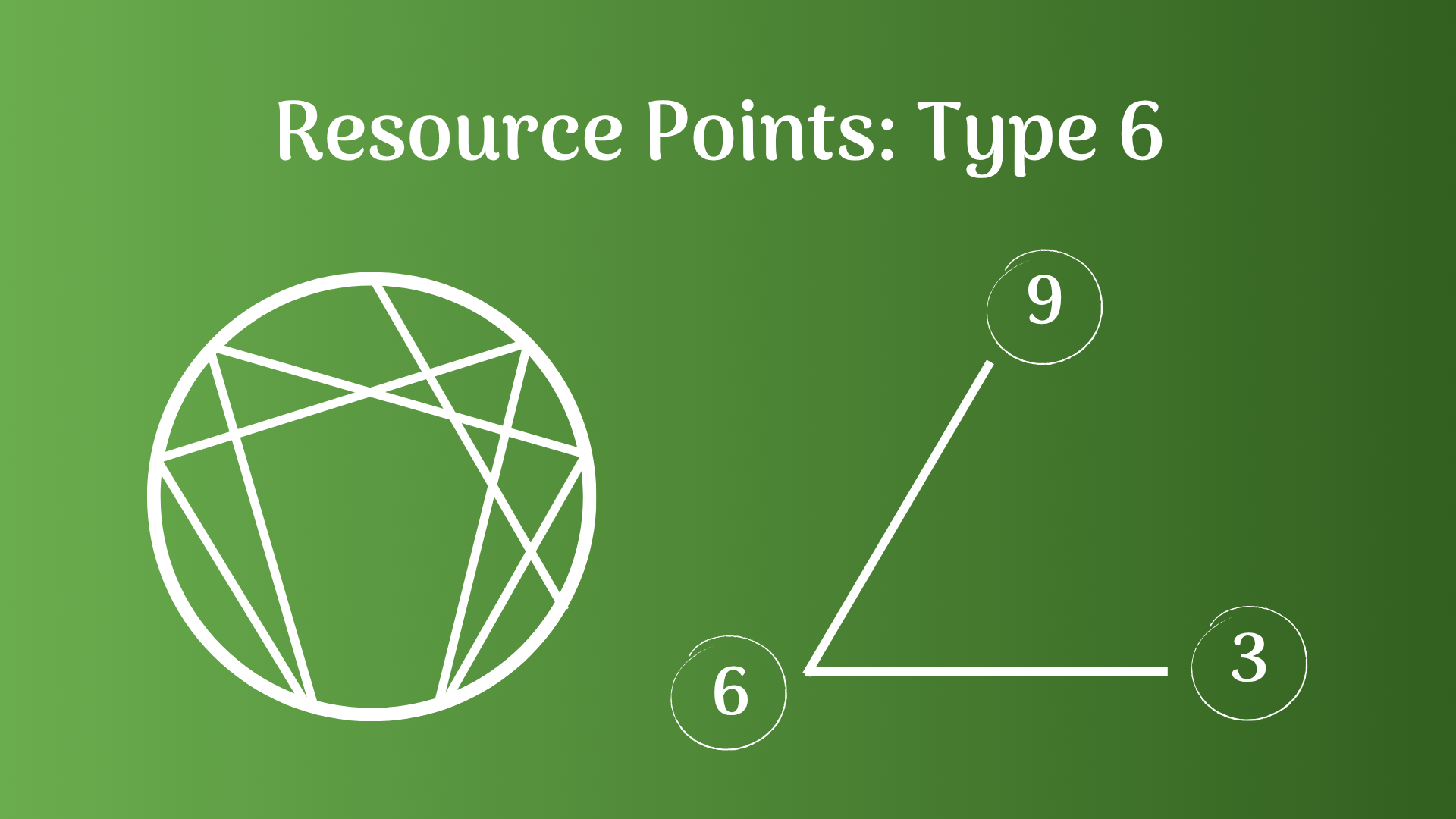
Welcome to the sixth post in our series on the Enneagram's connecting lines. So far, we've looked at the Resource Points for Types 1 through 5. Now we're moving on to Type 6. As a reminder, "Resource Points" is the language we're using because it moves us away from thinking of one line as the good one and the other as the bad one, and toward the idea that both territories hold answers to the problems of our home type.
To understand what 6s are drawing on when they move along their lines, it helps to first understand what's happening at home.
Type 6 and the Head Triad
As members of the Head Triad, 6s are concerned with safety, security, and certainty. They want to predict and prepare for the "danger out there." These are the questioners who don't take things at face value. They look for what is behind the facade. Doubting reality is a standard practice.
What keeps 6s from fulfillment is a lack of trust in their surrounding environment, and a lack of trust in themselves. They find themselves hesitating rather than acting OR leaping into action to counter their fear/doubt. Both approaches betray an assumption that the worst case scenario is the most likely scenario.
There's a certain unwillingness to operate from the assumption that "maybe everything will work out," because 6s feel this would be the same as letting their guard down.
In other words, the preparedness and sharp questioning we see on the outside are tied to a vigilance that rarely gets to rest on the inside.
Movement Along the Lines: Loosening Fear and Developing Faith
For 6s, movement along the lines is all about loosening their grip on fear/anxiety and developing faith in themselves.They fail to see that fearfulness and safety actually don't go together. If the strategy to be safe is "widening one's net of anxiety" to catch incoming hazards, the self-defeating prophecy has already been fulfilled. In this paradigm 6s never FEEL safe (even when they genuinely are).
When 6s stop over-focusing on hazards, they become capable, astute, and insightful. Their intuition is no longer blurred by fear.
All of this becomes possible when 6s access their Resource Points.
Making Conscious Movement
As we discussed in the intro, what makes the lines useful is conscious movement, rather than something that just happens to us. For 6s, the way to achieve conscious movement along the inner lines is to be awake to one's own patterns, and to observe when automatic habit takes over.
Through self-observation, 6s learn to "repeatedly unhook their attention" from worst-case-scenario imaginings. That word repeatedly matters. The attention gets hooked again and again, and the practice is to keep noticing it and unhooking it, each time it happens.
When they are awake to themselves and present in the moment, they get the best of their Resource Points.
Point 3
Here, 6s find efficiency and go-ahead energy. Hesitation and doubt soften back, and they choose action over procrastination.
Remember that 6s can get stuck hesitating, and that doubt is a standard practice. Point 3 is where that doubt can be set down. Drawing on their resources at point 3, 6s find the ability to set aside their doubt for the sake of productivity. They're less driven to "defer out" their decision-making.
Point 9
Here, 6s find some "chill." They are able to contact their trusting nature, sink into comfort, and relax their vigilance.
Remember that 6s feel that relaxing would be the same as letting their guard down. Point 9 is where that equation gets challenged. Drawing on their resources at point 9, 6s learn that relaxation does not entirely preclude safety, and also that relaxing FEELS GOOD if they allow it.
When Action and Chill Get Complicated
Generally speaking, point 9 is the growth point for 6s, and tends to light up when they're feeling expansive. Point 3 is the stress point, and tends to light up when they're feeling contracted. But because each Resource Point holds a full range, neither one is automatically a smooth ride (or automatically a rough one). Remember, we're not sorting these into "good" and "bad."
At point 3, the go-ahead energy can show up in less conscious ways. Efficiency can turn into the "leaping into action to counter fear" we described at home, where the doing is really a way of outrunning the doubt, rather than setting it aside. Or the doubt doesn't actually soften, and just gets buried under a to-do list, ready to resurface later. When 6s are awake and present, though, point 3 is what we described above: efficiency and go-ahead energy, with action chosen over procrastination.
At point 9, the invitation to relax can go sideways too. Since relaxing feels like letting their guard down, the "chill" can get interrupted by a wave of anxiety, or by the sense that something must be about to go wrong. Or comfort can turn into checking out and avoiding, rather than a genuine sinking into trust. With conscious movement, point 9 is where 6s contact their trusting nature, and relax their vigilance.
This is exactly why conscious movement matters so much. Both points hold the full range, and self-observation is what helps 6s draw on the healthier end of each.
Action and Chill: Two Resources, One Pattern
Taken together, the two Resource Points address the two sides of the pattern we started with. Point 3 offers go-ahead energy that cuts through hesitation, so decisions don't have to be deferred out. Point 9 offers trust, comfort, and relaxed vigilance, so safety no longer depends on staying on guard. Neither asks a 6 to stop being prepared, and neither is a "reward" or a "punishment." They're two territories where 6s can find what their home type has a hard time granting itself.
Questions to Sit With
If you're a 6, or you love one, here are a few questions drawn from everything above:
Am I assuming the worst case scenario is the most likely scenario?
What would it be like to consider that "maybe everything will work out"?
Can I let myself relax, even for a moment, and notice how it FEELS?
The Takeaway for Type 6
It's possible to be cautious, prepared, AND lean into stances of forward-moving efficiency and comfortable repose.
Next up in the series, we'll move on to Type 7 and explore their Resource Points. If you'd like to explore Type 6 growth themes more deeply, check out our monthly support groups held on the first Sunday of each month, or our next monthly workshop. You can learn more and register here.