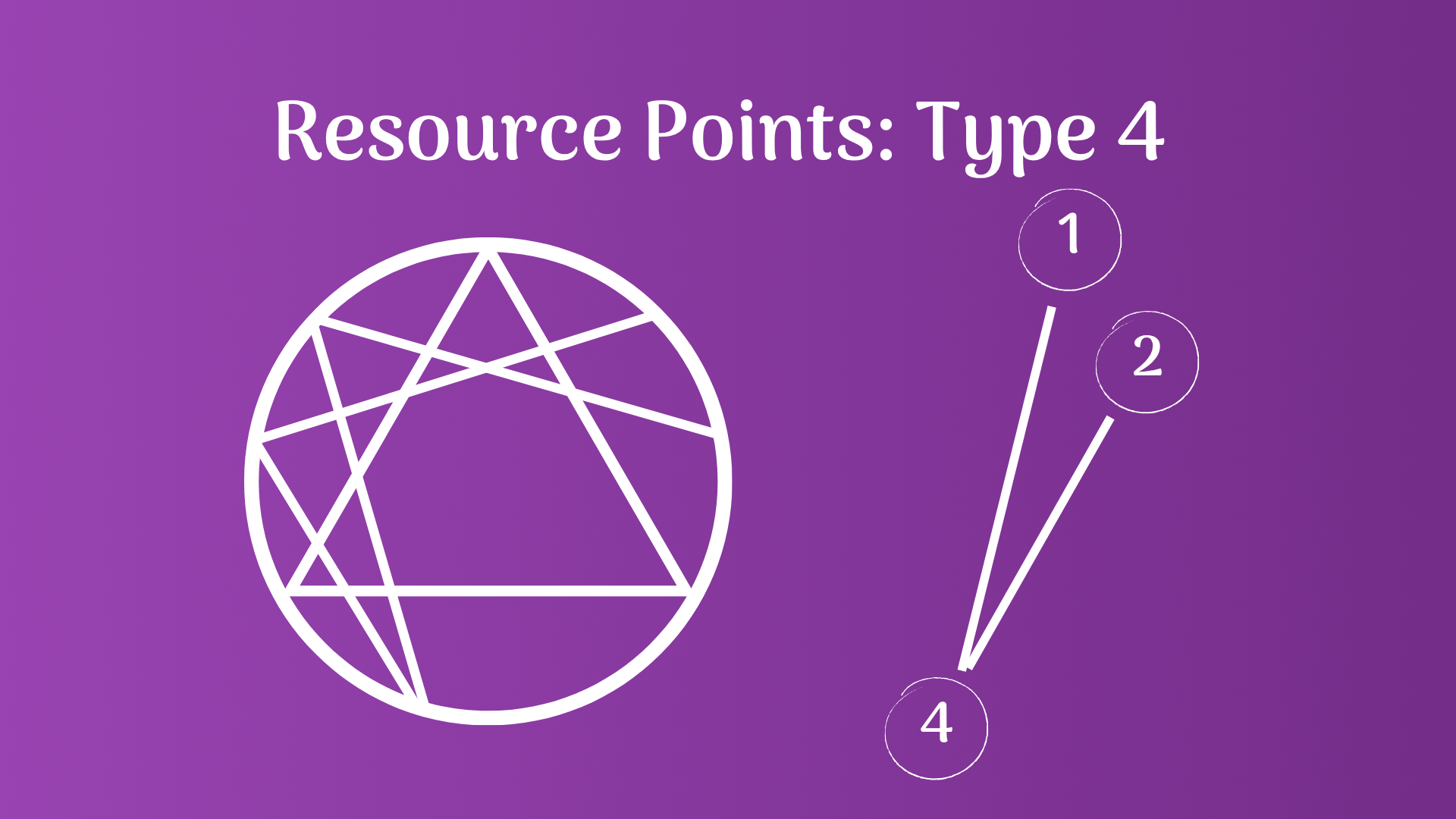
Welcome to the fourth post in our series on the Enneagram's connecting lines. So far, we've looked at the Resource Points for Types 1, 2, and 3. Now we're moving on to Type 4. As a reminder, "Resource Points" is the language we're using because it moves us away from thinking of one line as the good one and the other as the bad one, and toward the idea that both territories hold answers to the problems of our home type.
To understand what 4s are drawing on when they move along their lines, it helps to first understand what's happening at home.
Type 4 and the Heart Triad
As members of the Heart Triad, 4s are concerned with connection and image. They want to be seen for their originality, and they seek out people who can understand their personal depth. Their self-image is built on the differences between themselves and others, which makes them feel simultaneously special and misunderstood.
What keeps 4s from fulfillment is the belief that the happiness enjoyed by others is inherently unavailable to them (as though they are missing an essential piece, while others are whole). This belief causes 4s to identify as outsiders or victims, and to dwell within their own interiors, in a world of fantasy and idealization, often accompanied by "overtaking" emotions that can sweep them away.
In other words, the depth and originality we see on the outside is tied to a private world where it can be hard to find the way out.
Movement Along the Lines: Loosening Identification with Feelings
For 4s, movement along the lines is all about loosening their identification with feelings and mood states. They can catapult themselves forward into growth with the realization that they are not their feelings.
When 4s stop attaching their identity to how they feel, and learn to conceive of emotions as "passing energetic movements," they can manage an escape from their own interiors, and from the turmoil they often find there.
All of this becomes possible when 4s access their Resource Points.
Making Conscious Movement
As we discussed in the intro, what makes the lines useful is conscious movement, rather than something that just happens to us. For 4s, the way to achieve conscious movement along the inner lines is to be awake to one's own patterns, and to observe when automatic habit takes over.
Through self-observation, 4s learn to "repeatedly unhook their attention" from what they perceive to be missing (in themselves, in others, and in the world). That word repeatedly matters. The attention gets hooked again and again, and the practice is to keep noticing it and unhooking it, each time it happens.
When they are awake to themselves and present in the moment, they get the best of their Resource Points.
Point 2
Here, 4s find the ability to purposefully direct attention toward what's going on inside of others (rather than on their own internal responses).
Remember that 4s tend to dwell within their own interiors. Point 2 is where attention can travel outward. Drawing on their resources at point 2, 4s learn to distribute their attention more evenly between their own feelings and those of others. In this state, their empathy is no longer an involuntary reaction, but rather an intentional response.
Point 1
Here, 4s find a blend of expressiveness and discipline, making their way from the realm of emotive fantasy into the realm of objectivity and concrete action.
Remember that 4s can be swept away by "overtaking" emotions and a world of fantasy and idealization. Point 1 is where that energy gets a destination. Drawing on their resources at point 1, 4s learn to channel their expressive nature into consistent and meaningful action.
When Attention and Action Get Complicated
Generally speaking, point 1 is the growth point for 4s, and tends to light up when they're feeling expansive. Point 2 is the stress point, and tends to light up when they're feeling contracted. But because each Resource Point holds a full range, neither one is automatically a smooth ride (or automatically a rough one). Remember, we're not sorting these into "good" and "bad."
At point 2, the shift of attention toward others can show up in less conscious ways. Attention that moves outward can turn into getting swept up in the feelings of others, which is really just the home type's "overtaking" emotions, with a new cast of characters. Or empathy can slip back into an involuntary reaction, rather than the intentional response we described above. When 4s are awake and present, though, point 2 is what we described above: attention distributed more evenly between their own feelings and those of others.
At point 1, the blend of expressiveness and discipline can go sideways too. Discipline can turn into a harsh inner critic, holding every feeling and every action up to a standard of "how it should be." Or the objectivity can become a way of cutting off from the emotional depth that is so central to 4s, rather than a way of giving that depth a form. With conscious movement, point 1 is where 4s blend expressiveness and discipline, and move from emotive fantasy into concrete action.
This is exactly why conscious movement matters so much. Both points hold the full range, and self-observation is what helps 4s draw on the healthier end of each.
Attention and Action: Two Resources, One Pattern
Taken together, the two Resource Points address the two sides of the pattern we started with. Point 2 offers attention that can be directed outward, and an empathy that's intentional rather than involuntary. Point 1 offers a way to channel expressiveness into consistent and meaningful action. Neither asks a 4 to give up their depth, and neither is a "reward" or a "punishment." They're two territories where 4s can find what their home type has a hard time granting itself.
Questions to Sit With
If you're a 4, or you love one, here are a few questions drawn from everything above:
Can I let this feeling be a passing energetic movement, rather than who I am?
Where is my attention going right now: toward what's missing, or toward what's here?
What is one small, concrete action I can take to give this feeling a form?
The Takeaway for Type 4
It's possible to be original, know the depth of your own identity, AND be practical-minded with the ability to focus attention outside of oneself.
Next up in the series, we'll move on to Type 5 and explore their Resource Points. If you’d like to explore Type 3 growth themes more deeply, check out our monthly support groups held on the third Monday of each month or our next monthly workshop. You can learn more and register here.