In the intro to this series, we looked at the Levels of Health: Riso & Hudson's "continuum of psychological functioning" for the Enneagram of Personality, and the way our "mood" stretches like a rubber band around the Level where we currently reside. Now we'll go through the continuum one Type at a time, starting with Type 1.
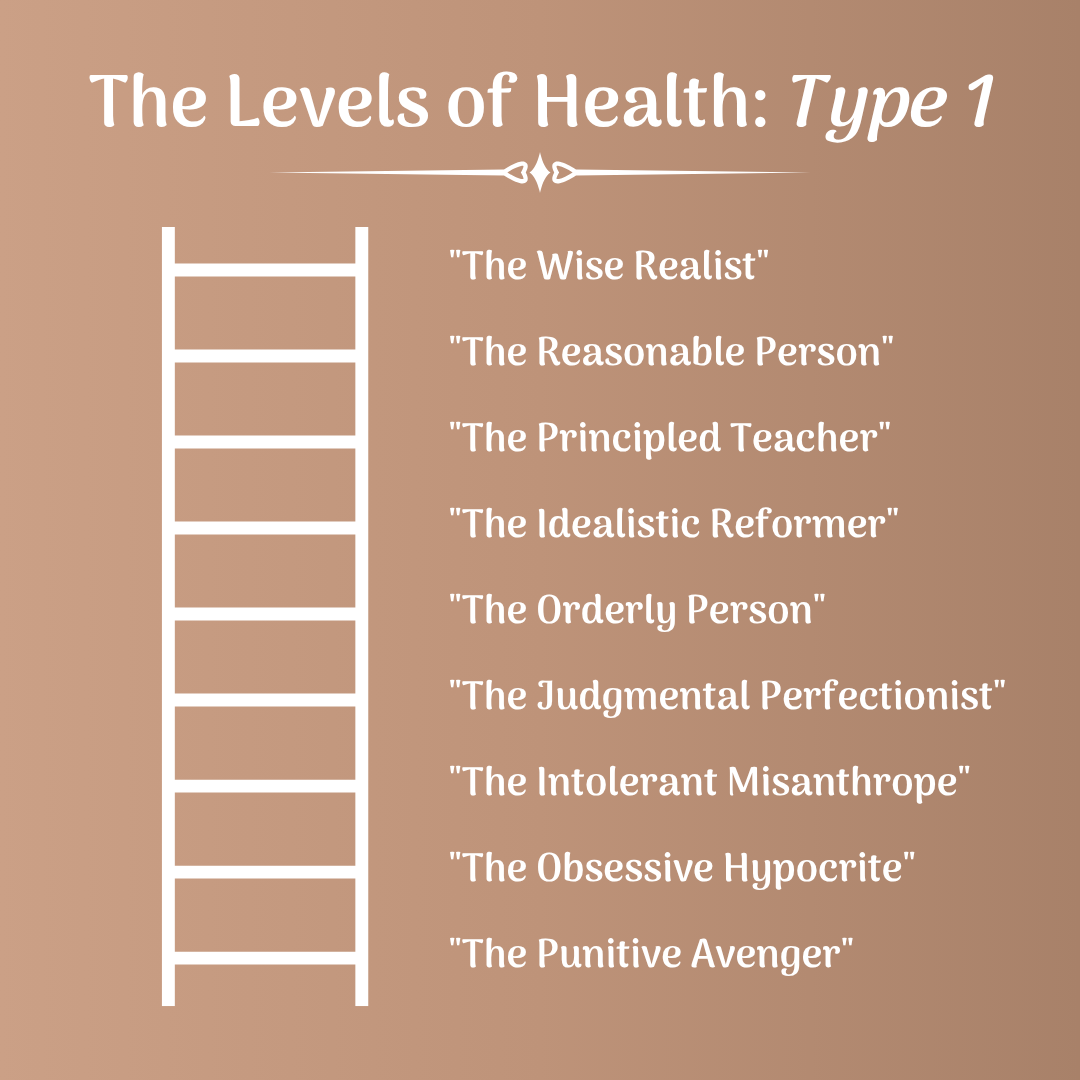
For Type 1, the continuum (as laid out in Riso & Hudson’s book Personality Types) runs from "The Wise Realist" at Level 1 all the way down to "The Punitive Avenger" at Level 9. Same Type, very different expressions of it.
At Their Best
At their best, Enneagram 1s understand that integrity takes many forms. They understand it is not their right nor their duty to change other people. They simply use their skills of discernment, and providing structure, to make things better wherever they see room for improvement.
Healthy 1s understand that “perfection is the enemy of the good.” They have no inclination towards criticism or judgment, but they still love organized effort and working hard towards positive change.
Most importantly, healthy 1s allow themselves pleasure. They rest in the knowledge that it is not wrong to feel good.
As 1s Move Down the Levels
As 1s begin to move down within the Levels of Health, this picture changes. Discernment degrades into rigid, black-and-white thinking and harsh judgments. Their ‘eye for error’ degrades into pervasive flaw-finding. And their overall improvement-orientation degrades into perfectionism and a grating sense of dissatisfaction with reality.
Notice that nothing new has been added here. The very same gifts are still present; they've simply lost their balance. The skill that once made things better now mostly finds what's wrong.
Good Intentions at Every Level
1s genuinely want to achieve excellence, do things right, and model integrity for others. At almost any level of health, 1s are bound to THINK this is what they are doing (whether or not that is true in reality).
But in the lower levels of health, the desire for excellence degrades into self-reproach, and chastising others for mistakes.
A Closer Look at the Nine Levels
In Personality Types, Riso & Hudson give every Type its own set of names for the nine Levels. For Type 1, they run from “The Wise Realist” at Level 1 down to “The Punitive Avenger” at Level 9. Let’s take them three at a time.
The Healthy Levels (1-3):
“The Wise Realist”
“The Reasonable Person”
“The Principled Teacher”
Across these three Levels, a 1 accepts reality as it is, imperfections and all. This is where “perfection is the enemy of the good” lives, and where 1s allow themselves pleasure, resting in the knowledge that it is not wrong to feel good. They still have clear ideas about what’s “right,” but they hold those ideas flexibly. They aren’t threatened by people who see things differently, and they have no inclination towards criticism or judgment. And their principles show up in action: they use their discernment and their skill at providing structure to make things better wherever they see room for improvement. The “Teacher” isn’t about taking on a duty to change other people. It’s about modeling integrity.
The Average Levels (4-6):
“The Idealistic Reformer”
“The Orderly Person”
“The Judgmental Perfectionist”
This is where most people reside, and it’s where the picture starts to shift. The idealism is still there, but it starts to become more about how things SHOULD be. The love of structure starts to become a need for order. And by the time we reach Level 6, discernment has hardened into the rigid, black-and-white thinking and harsh judgments we talked about above. “Perfectionist” is no longer about excellence. It’s about dissatisfaction with reality. Even so, 1s at these Levels are (for the most part) functioning effectively in the world.
The Unhealthy Levels (7-9):
“The Intolerant Misanthrope”
“The Obsessive Hypocrite”
“The Punitive Avenger”
These names are heavy, and they’re meant to be. This is the area of the continuum where the false premises of personality run the show. The irritation and resentment we described earlier harden into something much harsher. And remember, 1s at almost any Level are bound to think they’re doing the right thing, so the “Hypocrite” label is a reminder of how far that can drift from reality. As always, these names describe levels of suffering, not anyone’s worth as a person.
Where Mood Comes In
Remember Riso & Hudson’s pegboard analogy from the intro to this series? The wooden peg is the Level where you reside, and the rubber band hanging from it is your “mood.”
Here’s what that might look like for a 1 who resides at Level 5, “The Orderly Person.” On a good day, the rubber band stretches upward, and that 1 might feel and function more like “The Reasonable Person” or even “The Principled Teacher.” They’re a little more flexible, and a little easier on themselves and others. On a hard day, the rubber band stretches downward, and the flaw-finding and irritation might start to look a lot more like “The Judgmental Perfectionist.”
But in both cases, the peg hasn’t moved. That means a rough day doesn’t mean you’ve lost ground. And a great day is worth celebrating, but it’s a stretch of the rubber band, not a move of the peg. Moving the peg takes growth and self-work over time (or stress and discomfort over time), and we’re talking about months or more.
The Body Center and “Gut Knowing”
A major factor to consider in all of this is how 1s use their primary center of intelligence (the Body center). According to Ginger Lapid-Bogda, “Gut Knowing” is the productive use of the body center in type 1s.
We see this in healthy 1s: they have an instinctive sense for how things could be improved, and they strive to achieve that picture of excellence. They are resolute in their ideals, and dedicatedly on-task. They aren’t threatened by other people with differing opinions of what’s “right.”
When the Body Center Gets Distorted
As 1s move down in the levels of health, their primary center of intelligence starts becoming distorted. They begin to fall prey to a fundamental “misuse” of the body center: reactivity. Whatever reality presents, it tends to cause feelings of irritation and resentment, and (eventually) overt anger.
They put less energy towards improving the surrounding environment and more energy towards criticizing it.
Questions to Sit With
If you're a 1, or you love one, here are a few questions to carry with you:
When does your eye for improvement feel like discernment, and when does it feel like flaw-finding?
Where in your life do you allow yourself pleasure, and where does it still feel “wrong” to feel good?
What does irritation or resentment tend to be pointing to for you?
The Takeaway
Type 1 isn't one fixed experience. The same gifts (discernment, an instinct for how things could be better, a love of organized effort) can show up as wisdom, patience, and even pleasure, or as flaw-finding, self-reproach, and resentment. What changes isn't the Type. It's where a 1 currently resides on the continuum, and how freely the body center is being used.
If you want to join us in some interactive learning, you can check out our monthly support groups held on the first Sunday of each month or our next monthly workshop. Learn more and register here!
Next up: Type 2.