Okay, so you know your Enneagram number. You know your Wing. You know your Instinctual Subtype. That must be everything there is to know about your Type, right? Well, not quite. There's yet another factor that affects your unique expression of Type.
A Continuum of Psychological Functioning
Don Riso & Russ Hudson were the first to map out a "continuum of psychological functioning" for the Enneagram of Personality, which they call the "Levels of Development." (Also referred to as the "Levels of Health.")
The easiest way to picture it is a ladder with nine rungs. Your Type, Wing, and Instinctual Subtype tell you a lot about the flavor of your personality. The Levels tell you something different: how much of the time that personality is running the show, and how much room you have to move beyond it.
Each rung has a name, and those names say a lot about what's going on at that point on the continuum:
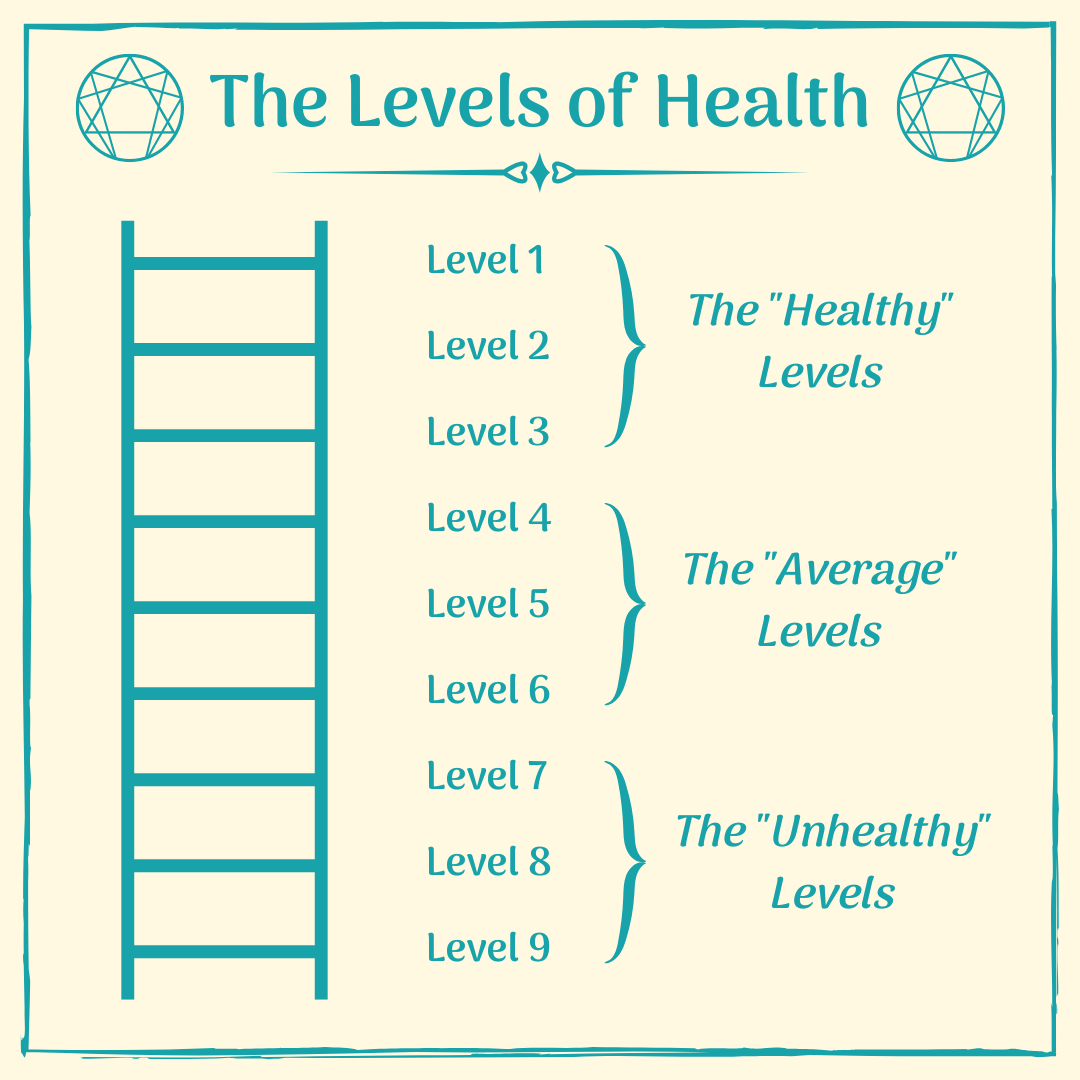
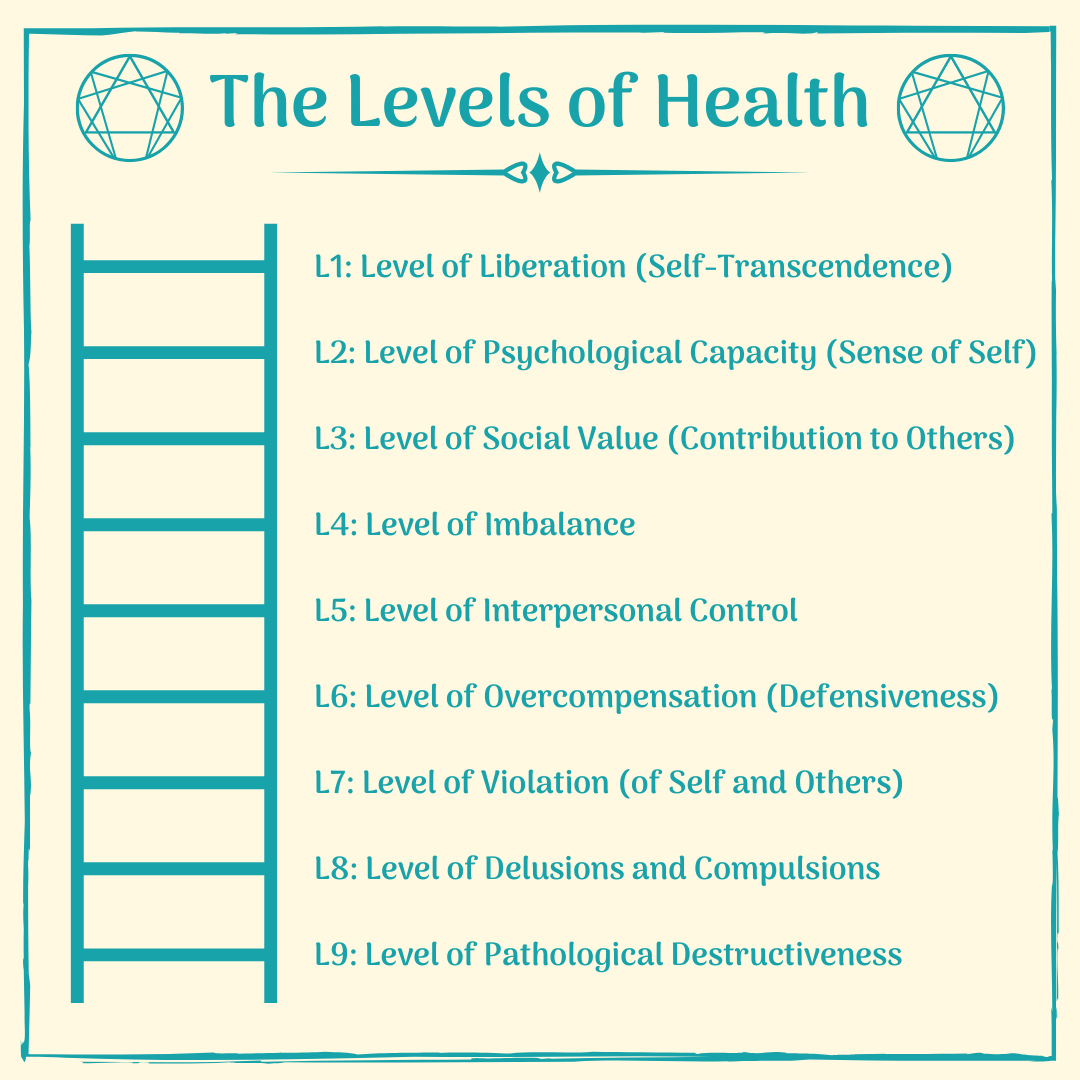
The nine Levels fall into three zones of three. Let's walk through each one.
The Healthy Levels (1-3)
Levels 1-3 essentially describe high psychological functioning. Individuals residing in this area of the continuum are moving towards transcendence, getting ever closer to living in their "essence" rather than operating on conditioned personality. There is very little psychological suffering here.
Notice how the names of these first three Levels move outward: from freedom (Liberation), to a stable and grounded sense of who you are (Psychological Capacity), to what you're able to offer the people around you (Social Value). As the grip of conditioned personality loosens, there's simply more of you available, for yourself and for others.
The Average Levels (4-6)
Levels 4-6 essentially describe "average" psychological functioning. This is what we're used to seeing in daily life. Most people reside here. There's usually some moderate psychological suffering in these levels, but folks who reside here are (for the most part) effectively functioning in the world.
The names of these Levels (Imbalance, Interpersonal Control, and Overcompensation) hint at what the moderate suffering looks like. This is where the habits of our Type start to harden into defenses, and where we start leaning on familiar strategies to manage our relationships and our anxieties. It's also where a lot of us are quietly doing our best.
The Unhealthy Levels (7-9)
Levels 7-9 are, for lack of a better term, the "unhealthy levels." Those who reside here experience deep psychological suffering of one kind or another, though they're not necessarily able to admit it to themselves or others. These levels are where we see the exhibition of pathological behavior. This is the area where "the false premises of personality" run the show entirely, and psychological self-destruction looms on the horizon.
A word of care: these labels describe levels of suffering and functioning. They are not a verdict on anyone's worth. Understanding this part of the continuum is about recognizing when someone (including ourselves) is in real pain and needs real support.
So What About "Mood?"
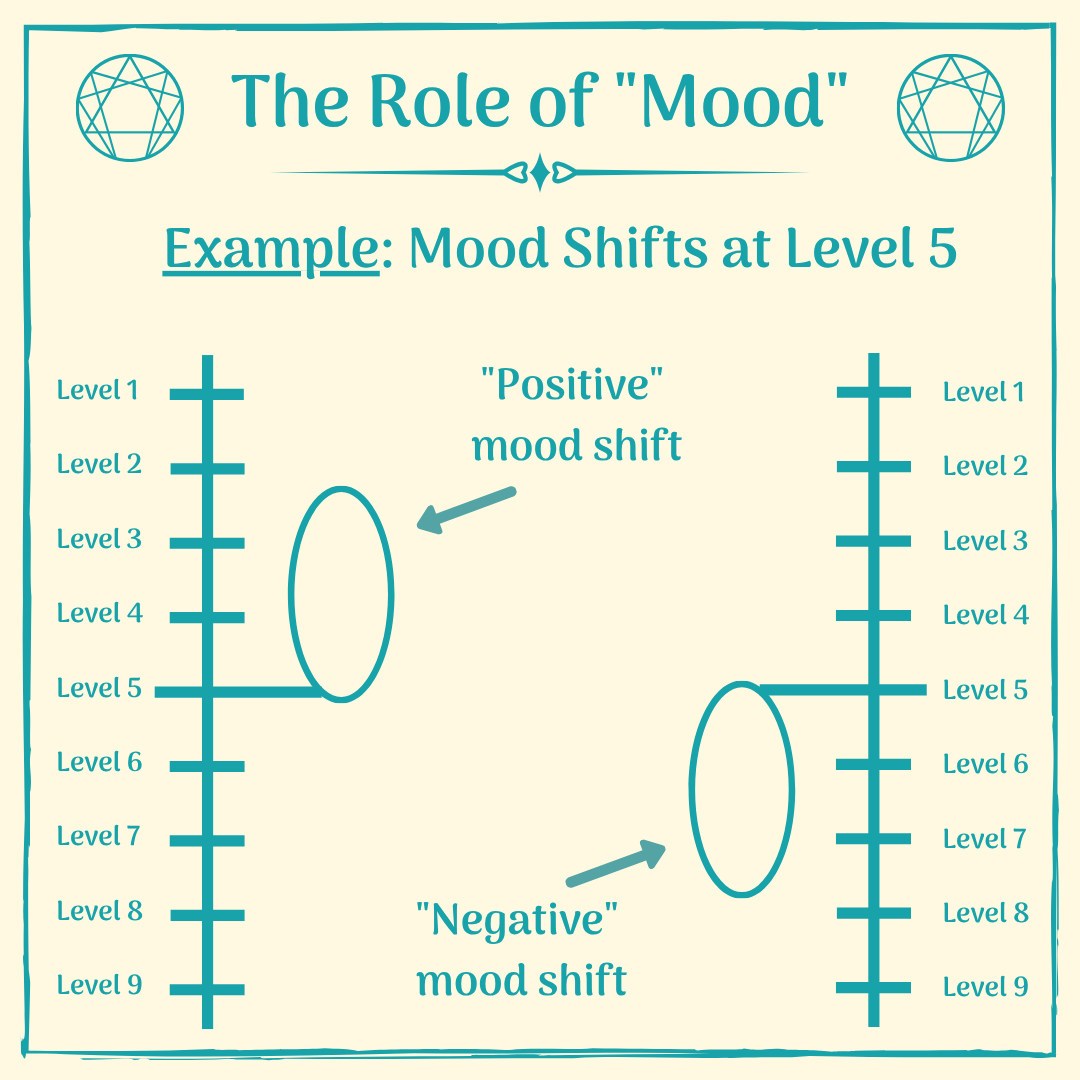
Riso & Hudson offer the following analogy. Imagine a wooden pegboard, with 9 holes drilled in it; these are the Levels of Health. Imagine a wooden peg rests in one of the 9 holes; this is the Level where you currently reside. And then there's a rubber band hanging from the wooden peg; this is your "mood."
The graphic shows how this plays out for someone who resides at Level 5. On a good day, the rubber band stretches upward and they may function more like Levels 3 or 4. On a hard day, it stretches downward, toward Levels 6 or 7. In both cases, the peg itself hasn't moved.
That's because the peg and the rubber band move on very different timelines. It takes a lot of growth / self-work over time to move the peg up to the next hole. And it takes a lot of stress or discomfort over time to move the peg down a hole. In either case, we're talking about months or more. But stretching the rubber band doesn't take much: mood shifts occur from day to day, or even within the same day.
In the next posts in this series, we'll go through the Levels of Health one Type at a time, from Type 1 through Type 9, to see how each Type's journey up and down the continuum looks.