In the intro to this series, we looked at the Levels of Health: Riso & Hudson's "continuum of psychological functioning" for the Enneagram of Personality, and the way our "mood" stretches like a rubber band around the Level where we currently reside. We started going through the continuum one Type at a time with Type 1. Now it's time for Type 2.
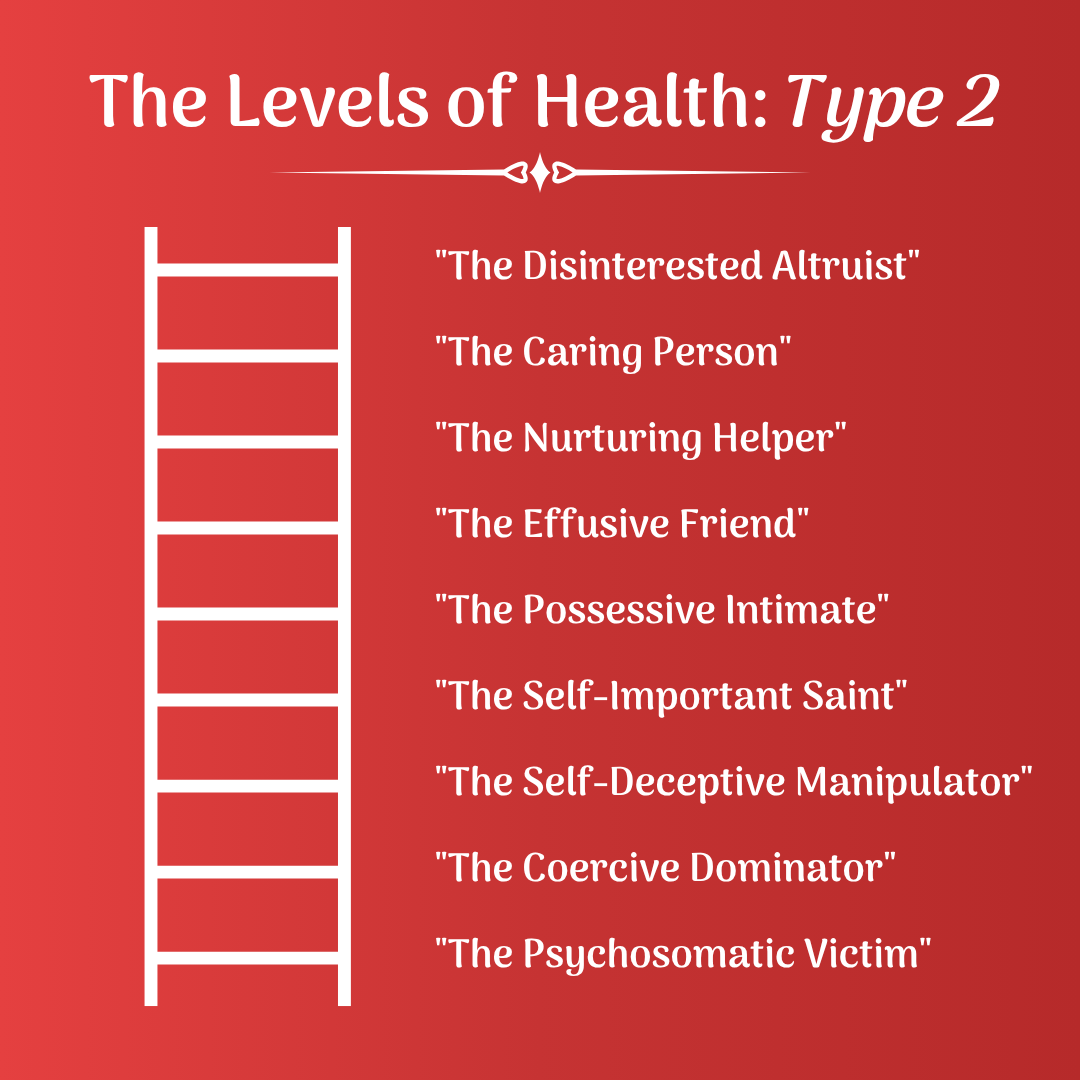
For Type 2, the continuum (as laid out in Riso & Hudson's book Personality Types) runs from "The Disinterested Altruist" at Level 1 all the way down to "The Psychosomatic Victim" at Level 9. Same Type, very different expressions of it.
At Their Best
At their best, Enneagram 2s understand that offering themselves love allows them to give to others in more profound ways. They are able to receive as well as give, which allows them to genuinely integrate others’ appreciation (while not feeling entitled to it). They use their emotional intelligence and capacity for connection to nourish themselves and others in pure/honest ways.
Healthy 2s understand they’re inherently worthy of love. They know their value is not predicated on others’ responses to them, so they give without urgency or expectation.
Most importantly, they know it’s not selfish to pay attention to their own needs. This allows them to address those needs directly, instead of depending on others to do it for them.
As 2s Move Down the Levels
As 2s begin to move down within the Levels of Health, this picture changes. Genuine altruism degrades into reciprocal giving. Self-care becomes taboo. Disinterested supportiveness degrades into self-serving, false generosity. They may try to enforce “relationship contracts” with others who had no hand in drafting said contracts, and never agreed to sign.
Notice that nothing new has been added here. The very same gifts are still present; they’ve simply lost their balance. The giving that once flowed freely now comes with strings attached.
Good Intentions at Every Level
2s genuinely want to be helpful and make sure others are loved and cared for. At almost any level of health, 2s are bound to THINK this is what they are doing (whether or not it’s true in reality).
But in the lower levels of health, their helping starts to look more like manipulation.
A Closer Look at the Nine Levels
In Personality Types, Riso & Hudson give every Type its own set of names for the nine Levels. For Type 2, they run from “The Disinterested Altruist” at Level 1 down to “The Psychosomatic Victim” at Level 9. Let’s take them three at a time.
The Healthy Levels (1-3):
“The Disinterested Altruist”
“The Caring Person”
“The Nurturing Helper”
Across these three Levels, a 2 offers themselves love first, which allows them to give to others in more profound ways. They know they’re inherently worthy of love, so they give without urgency or expectation. (“Disinterested” here doesn’t mean uninterested. It means giving without an agenda.) They can receive as well as give, taking in others’ appreciation without feeling entitled to it. And they know it’s not selfish to pay attention to their own needs, so they address those needs directly.
The Average Levels (4-6):
“The Effusive Friend”
“The Possessive Intimate”
“The Self-Important Saint.”
This is where most people reside, and it’s where the picture starts to shift. The giving starts to become reciprocal, with a growing expectation of something in return. Self-care starts to become taboo. And those “relationship contracts” we mentioned earlier start to show up, with 2s expecting others to honor agreements they never signed. Even so, 2s at these Levels are (for the most part) functioning effectively in the world, and they genuinely want to be helpful.
The Unhealthy Levels (7-9):
“The Self-Deceptive Manipulator”
“The Coercive Dominator”
“The Psychosomatic Victim”
These names are heavy, and they’re meant to be. This is the area of the continuum where the false premises of personality run the show. The helping that started out as genuine altruism now looks a lot more like manipulation. And remember, 2s at almost any Level are bound to THINK they’re being helpful, so “Self-Deceptive” is a reminder of how far that can drift from reality. As always, these names describe levels of suffering, not anyone’s worth as a person.
Where Mood Comes In
Remember Riso & Hudson’s pegboard analogy from the intro to this series? The wooden peg is the Level where you reside, and the rubber band hanging from it is your “mood.”
Here’s what that might look like for a 2 who resides at Level 5, “The Possessive Intimate.” On a good day, the rubber band stretches upward, and that 2 might feel and function more like “The Nurturing Helper” or “The Effusive Friend.” They’re able to give with fewer strings attached, and a little more able to attend to their own needs. On a hard day, the rubber band stretches downward, and the expectations behind their giving might start to look a lot more like “The Self-Important Saint.”
But in both cases, the peg hasn’t moved. That means a rough day doesn’t mean you’ve lost ground. And a great day is worth celebrating, but it’s a stretch of the rubber band, not a move of the peg. Moving the peg takes growth and self-work over time (or stress and discomfort over time), and we’re talking about months or more.
The Heart Center and “Empathy”
A major factor to consider in all of this is how 2s use their primary center of intelligence (the Heart center). According to Ginger Lapid-Bogda, “Empathy” is the productive use of the Heart center in type 2s.
We see this in healthy 2s: they reach out with their hearts, and feel the needs of others. They serve those needs in appropriate, non-intrusive ways.
When the Heart Center Gets Distorted
As 2s start moving down in the levels of health, their primary center of intelligence becomes distorted. They begin to fall prey to a fundamental “misuse” of the Heart center: emotional manipulation.
They end up helping others to help themselves, not consciously aware that they’re seeking to get their own (repressed) needs met.
Questions to Sit With
If you’re a 2, or you love one, here are a few questions to carry with you:
When you give, can you tell the difference between giving freely and giving with an expectation of something in return?
What do you need right now, and how could you go about meeting that need directly?
Can you take in someone’s appreciation without feeling that you either owe something or deserve more?
The Takeaway
Type 2 isn’t one fixed experience. The same gifts (emotional intelligence, a capacity for connection, a genuine desire to help) can show up as honest nourishment for yourself and others, or as manipulation and self-serving generosity. What changes isn’t the Type. It’s where a 2 currently resides on the continuum, and how freely the heart center is being used.
If you’d like to explore Type 2 growth themes more deeply, check out our monthly support groups held on the first Monday of each month or our next monthly workshop. You can learn more and register here.
Next up: Type 3.