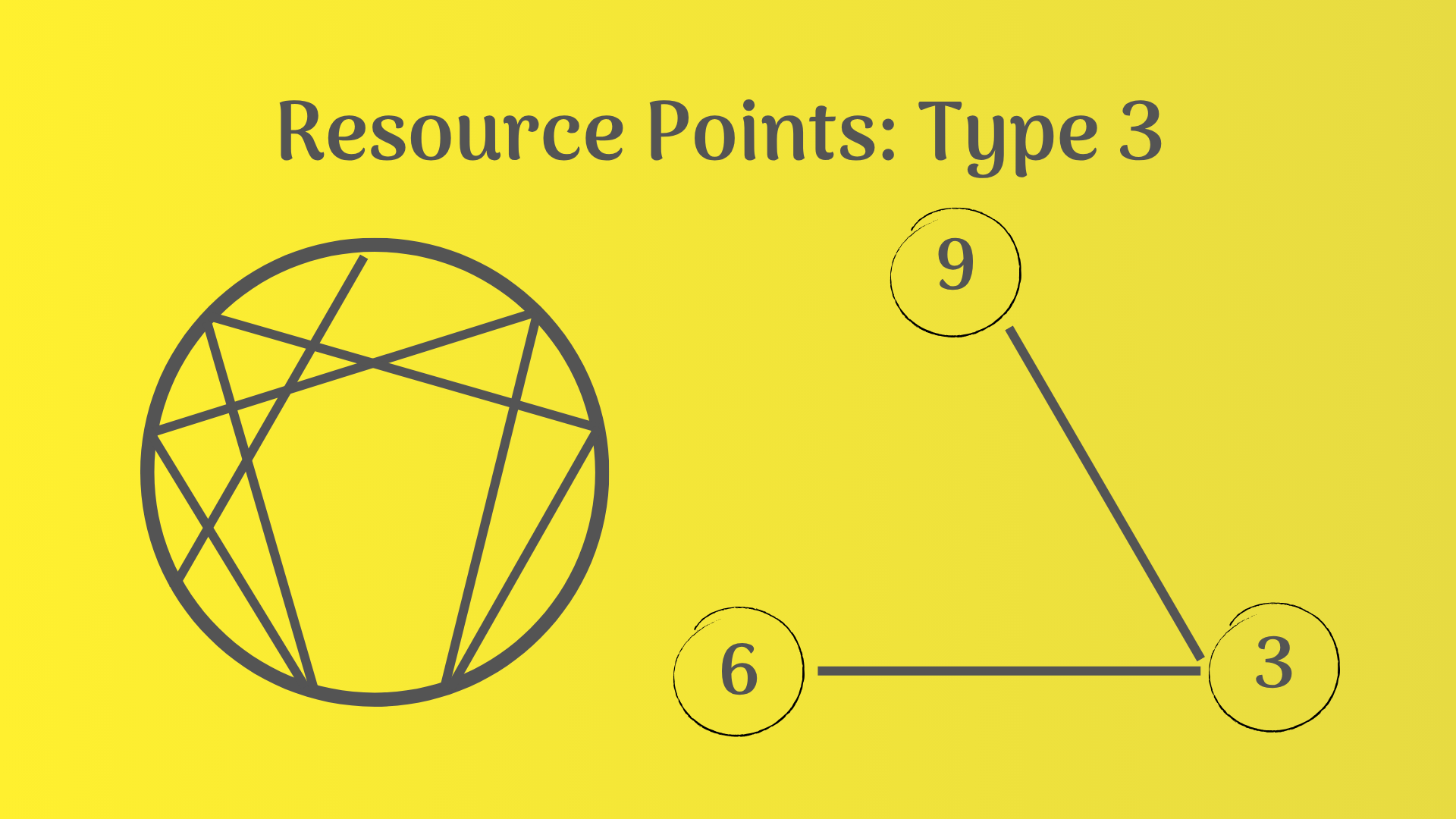
Welcome to the third post in our series on the Enneagram's connecting lines. So far, we've looked at the Resource Points for Type 1 and Type 2. Now we're moving on to Type 3. As a reminder, "Resource Points" is the language we're using because it moves us away from thinking of one line as the good one and the other as the bad one, and toward the idea that both territories hold answers to the problems of our home type.
To understand what 3s are drawing on when they move along their lines, it helps to first understand what's happening at home.
Type 3 and the Heart Triad
As members of the Heart Triad, 3s are concerned with connection and image. They seek the admiration of others, through smooth self-presentation and a winning attitude. They tend to believe they are what they do. These are the folks who can read a room and know exactly "who to be" in order to run that room.
What keeps 3s from fulfillment is the belief that personal value is an outgrowth of accomplishments. They may hide parts of themselves that don't fit their conception of a winner. Parts of oneself get discarded and then picked back up at will.
After a while, the adaptability of 3s becomes pure paradox: how is it possible to promote oneself without a stable sense of self? They can feel they don't "know themselves" outside of task-mode.
In other words, the polish and success we see on the outside can sit on top of a sense of self that's hard to locate on the inside.
Movement Along the Lines: Relaxing Task-Orientation
For 3s, movement along the lines is about relaxing task-orientation, and the urgent need to "shine." More than anything, they must understand their inherent worth. They can be loved and admired for their true selves, if willing to take the risk of being who they really are.
When 3s maintain hope that they'll still have value even in the face of failure, they leave space for doing AND "being." They become beyond inspirational, because they don't hide a single part of themselves, and others can follow that model of honesty.
All of this becomes possible when 3s access their Resource Points.
Making Conscious Movement
As we discussed in the intro, what makes the lines useful is conscious movement, rather than something that just happens to us. For 3s, the way to achieve conscious movement along the inner lines is to be awake to one's own patterns, and to observe when automatic habit takes over.
Through self-observation, 3s learn to "repeatedly unhook their attention" from tasks/goals and social adaptation. That word repeatedly matters. The attention gets hooked again and again, and the practice is to keep noticing it and unhooking it, each time it happens.
When they are awake to themselves and present in the moment, they get the best of their Resource Points.
Point 9
Here, 3s find the ability to slow down, rest, and recharge. It's a respite from the busyness of completing tasks.
Remember that 3s can feel they don't "know themselves" outside of task-mode. Point 9 is where the tasks can finally be set down. When 3s draw on their resources at point 9, they can slow down, pause their striving, and enjoy what they already have.
Point 6
Here, the competitive edge of 3s softens. They become team players, finding satisfaction in collaboration and contribution, without needing to be atop the pyramid.
Remember that 3s tend to believe their value is an outgrowth of accomplishment. Point 6 is where that need to come out on top loosens. Drawing on their resources at point 6, 3s learn the joy of being part of a collective, and also learn to have some "healthy doubt" about their course of action, rather than putting the pedal to the metal all the time.
When Slowing Down and Teaming Up Get Complicated
Generally speaking, point 6 is the growth point for 3s, and tends to light up when they're feeling expansive. Point 9 is the stress point, and tends to light up when they're feeling contracted. But because each Resource Point holds a full range, neither one is automatically a smooth ride (or automatically a rough one). Remember, we're not sorting these into "good" and "bad."
At point 9, the permission to slow down can show up in less conscious ways. After so much time spent in task-mode, slowing down can turn into checking out or shutting down, rather than genuinely resting and recharging. Or rest becomes one more thing to do well - a "productive" recharge, which is really just the home type's task-orientation in disguise. When 3s are awake and present, though, point 9 is what we described above: slowing down, pausing the striving, and enjoying what they already have.
At point 6, the "healthy doubt" can go sideways too. Doubt about the course of action can slide into doubting EVERYTHING, which is a long way from the pedal-to-the-metal habit of the home type. And 3s can slip into treating the team as one more room to read - adapting to what the group wants, rather than genuinely contributing as themselves. With conscious movement, point 6 is where 3s find satisfaction in collaboration and contribution, without needing to be atop the pyramid.
This is exactly why conscious movement matters so much. Both points hold the full range, and self-observation is what helps 3s draw on the healthier end of each.
Rest and Belonging: Two Resources, One Pattern
Taken together, the two Resource Points address the two sides of the pattern we started with. Point 9 offers rest from the busyness of completing tasks, which makes room for "being." Point 6 offers a place in the collective, where value doesn't depend on being on top. Neither asks a 3 to stop achieving, and neither is a "reward" or a "punishment." They're two territories where 3s can find what their home type has a hard time granting itself.
Questions to Sit With
If you're a 3, or you love one, here are a few questions drawn from everything above:
Who am I when there's no task in front of me?
Can I enjoy what I already have, before reaching for what's next?
What would it be like to contribute to a group without needing to be on top?
The Takeaway for Type 3
It's possible to be successful, inspire those around you, AND find enjoyment in stillness and supporting group-efforts.
Next up in the series, we'll move on to Type 4 and explore their Resource Points.