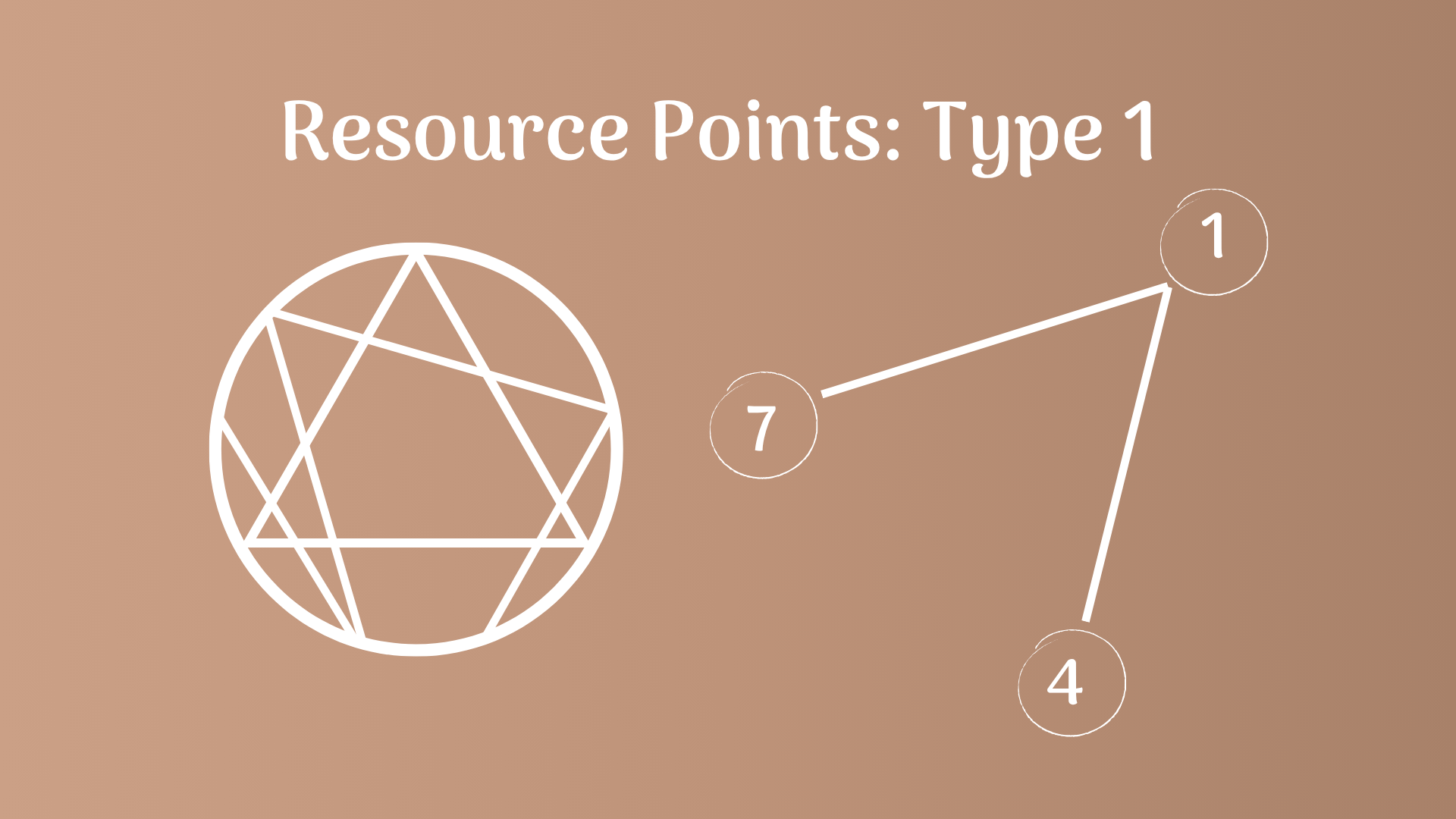
Welcome to the first post in our series on the Enneagram's connecting lines, where we'll look at each type's Resource Points one at a time. In the intro post, we talked about why "Resource Points" is the language we're using: it moves us away from thinking of one line as the good one and the other as the bad one, and toward the idea that both territories hold answers to the problems of our home type. Now it's time to see what that looks like in practice, and we're starting where the numbers start, with Type 1.
To understand what 1s are drawing on when they move along their lines, it helps to first understand what's happening at home.
Type 1 and the Body Triad
As members of the Body Triad, type 1s are concerned with control and autonomy. They certainly want to control their surrounding environment, to "make it better," by fixing what they perceive to be wrong with it. But that is all in the pursuit of being a good person.
So it's really more about what's going on inside. 1s try to assert control over their internal world first and foremost. They attempt to "edit out" thoughts, feelings, and instincts that they perceive as being wrong to have or display. 1s feel that if they do not exert control over their internal world, their base instincts will be running the show (and that will turn them into bad people).
In other words, the fixing and improving we see on the outside is the visible part of a much more private project. The real work is happening within.
Movement Along the Lines: Internal Permission
For 1s, I define their movement along the lines through the concept of "internal permission." My understanding of Type 1s is that they have trouble giving themselves permission for pleasure, and they also have trouble allowing permission for their thoughts, feelings, and instincts to operate freely. There is a tendency to cast pleasure as frivolous, and to view the expression of strong emotions and instincts as self-indulgence or "losing control of themselves."
It's worth noticing the word permission here. The thoughts, feelings, and instincts are already there. The question is whether a 1 allows them to operate freely, or whether they get edited out before they ever see the light of day. The same goes for pleasure: it's less about whether pleasure is available, and more about whether it's allowed.
The good news is that these tendencies can be softened quite a bit when 1s access their Resource Points.
Making Conscious Movement
As we discussed in the intro, what makes the lines useful is conscious movement, rather than something that just happens to us. For 1s, the way to achieve conscious movement along the inner lines is to be awake to one's own patterns, and to observe when automatic habit takes over.
Through self-observation, 1s learn to "repeatedly unhook their attention" from error correction and from noticing what's wrong about the surrounding environment. That word repeatedly matters. The attention gets hooked again and again, and the practice is to keep noticing it and unhooking it, each time it happens.
When they are awake to themselves and present in the moment, they get the best of their Resource Points.
Point 4
Here, 1s find the internal permission to express themselves honestly and organically, rather than having to be tightly self-controlled.
Remember that 1s are working to "edit out" the thoughts, feelings, and instincts they believe are wrong to have or display. Point 4 is where that editing can relax. They find themselves able to feel what they feel, and express it authentically, when they draw on the resources at point 4.
Point 7
Here, 1s find the internal permission to lighten up and have a good time. It's a respite from having to "work so hard to be good." Attention shifts from error to opportunity.
That shift in attention is exactly the unhooking described above: moving away from what's wrong and toward what's possible. Drawing on their resources at point 7, 1s learn the art of "finding the fun" in things (even in all of that hard work they do).
When Permission Gets Complicated
Generally speaking, point 7 is the growth point for 1s, and tends to light up when they're feeling expansive. Point 4 is the stress point, and tends to light up when they're feeling contracted. But because each Resource Point holds a full range, neither one is automatically a smooth ride (or automatically a rough one). Remember, we're not sorting these into "good" and "bad."
At point 4, the permission to feel can show up in less conscious ways. After so much time spent editing out feelings, they can come rushing in all at once, rather than flowing organically. Or the feelings that DO surface become one more thing to scrutinize and correct - which is really just the home type's habit of error correction, turned on the self. When 1s are awake and present, though, point 4 is what we described above: feeling what you feel, and expressing it honestly, without managing it first.
At point 7, the permission to lighten up can go sideways too. "Lightening up" can become a break FROM all that responsibility - a reaction against the hard work, rather than a way to find the fun inside of it. And since pleasure is still being cast as frivolous, guilt can follow close behind. But with conscious movement, point 7 is where attention shifts from error to opportunity.
This is exactly why conscious movement matters so much. Both points hold the full range, and self-observation is what helps 1s draw on the healthier end of each.
Two Permissions, One Pattern
Taken together, the two Resource Points address the two sides of the pattern we started with. Point 4 offers permission for thoughts, feelings, and instincts to operate freely. Point 7 offers permission for pleasure. Neither asks a 1 to stop caring about doing good, and neither is a "reward" or a "punishment." They're two territories where 1s can find what their home type has a hard time granting itself.
Questions to Sit With
If you're a 1, or you love one, here are a few questions drawn from everything above:
When a strong feeling shows up, do I allow it to be there, or do I edit it out first?
Where is my attention going right now: toward what's wrong, or toward what's possible?
Can I find the fun in the work I'm already doing?
The Takeaway for Type 1
It's possible to make things better, improve the world, be a good person, AND also have a rich life filled with pleasure, lightheartedness, and genuine expression.
Next up in the series, we'll move on to Type 2 and explore their Resource Points. If you want to join us in some interactive learning, you can check out our monthly support groups held on the first Sunday of each month or our next monthly workshop. Learn more and register here!