In the intro to this series, we looked at the Levels of Health: Riso & Hudson's "continuum of psychological functioning" for the Enneagram of Personality, and the way our "mood" stretches like a rubber band around the Level where we currently reside. We've been going through the continuum one Type at a time. Now it's time for Type 4.
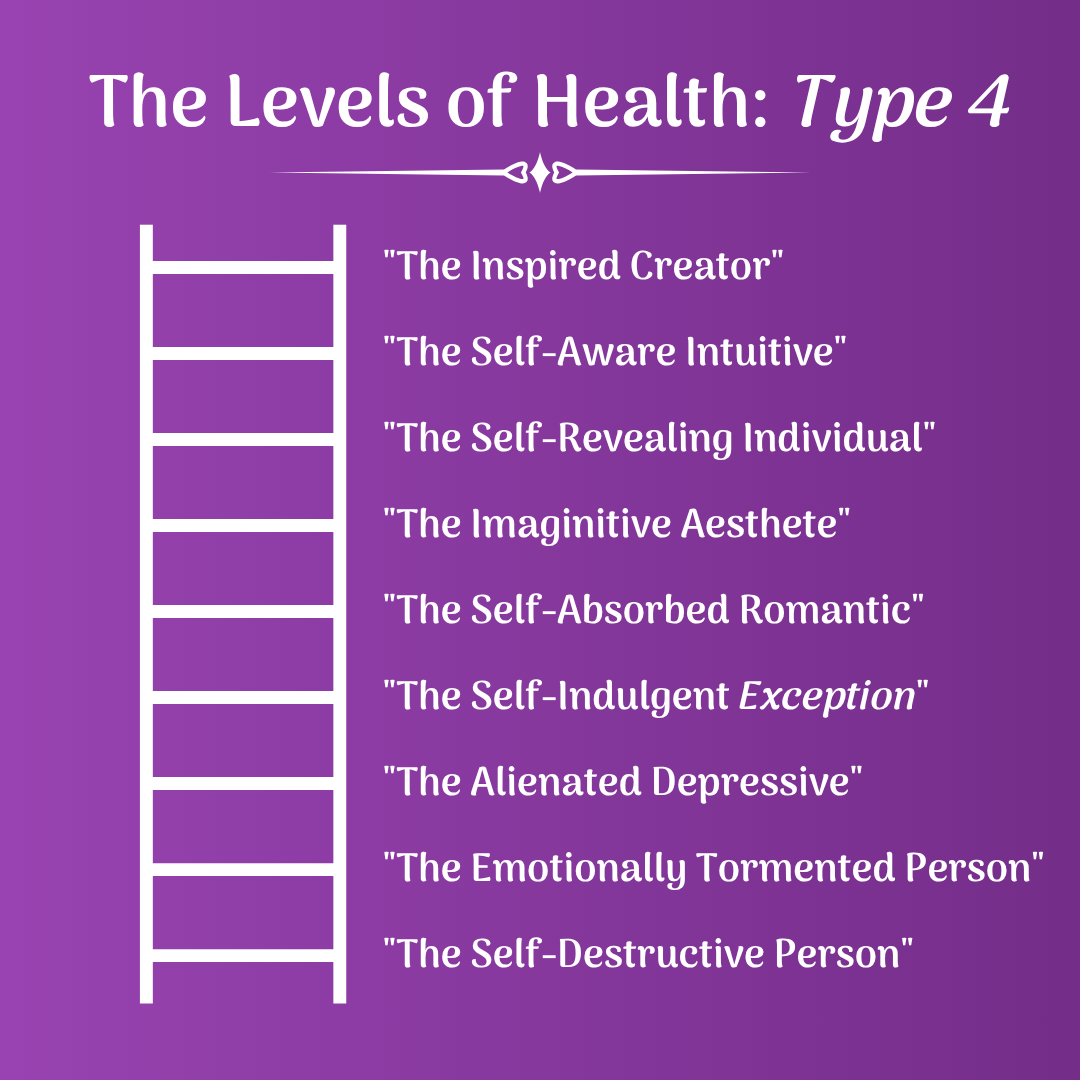
For Type 4, the continuum (as laid out in Riso & Hudson's book Personality Types) runs from "The Inspired Creator" at Level 1 all the way down to "The Self-Destructive Person" at Level 9. Same Type, very different expressions of it.
At Their Best
At their best, 4s are creative, compassionate, expressive, and have a wide emotional spectrum. Paradoxically, they can traverse the entirety of that emotional spectrum while retaining inner balance. They can make others feel seen and understood for who they really are.
Most importantly, healthy 4s feel their own wholeness. They know nothing is missing, and they find fulfillment in whatever the present moment offers. No need to compare their experience with others, no need to escape into fantasy. They no longer search for themselves; there’s a deep sense of already being “found.”
As 4s Move Down the Levels
As 4s move down within the levels of health, this picture changes. They lose their sense of inner balance, and start to dwell mostly in the “highs and lows” of their emotional spectrum. Self-authenticity degrades into self-absorption. And their sense of originality degrades into feeling “different”—like an outsider to whom happiness is simply unavailable. They reject their own good qualities.
Notice that nothing new has been added here. The very same gifts are still present; they’ve simply lost their balance. The depth of feeling that once connected 4s to others now mostly pulls them inward.
Good Intentions at Every Level
4s genuinely want to live into the truth of who they are. At almost any level of health, they are bound to THINK this is what they are doing.
But in the lower levels of health, their identification with victimhood may “block out” their authentic self.
A Closer Look at the Nine Levels
In Personality Types, Riso & Hudson give every Type its own set of names for the nine Levels. For Type 4, they run from “The Inspired Creator” at Level 1 down to “The Self-Destructive Person” at Level 9. Let’s take them three at a time.
The Healthy Levels (1-3):
“The Inspired Creator”
“The Self-Aware Intuitive”
“The Self-Revealing Individual”
Across these three Levels, a 4 is creative, compassionate, and expressive, with a wide emotional spectrum that they can traverse while retaining inner balance. They can make others feel seen and understood for who they really are. Most importantly, they feel their own wholeness. They know nothing is missing, they find fulfillment in whatever the present moment offers, and there’s no need to compare their experience with others or escape into fantasy. They no longer search for themselves, because there’s a deep sense of already being “found.”
The Average Levels (4-6):
“The Imaginative Aesthete”
“The Self-Absorbed Romantic”
“The Self-Indulgent Exception”
This is where most people reside, and it’s where the picture starts to shift. 4s lose their sense of inner balance, and start to dwell mostly in the “highs and lows” of their emotional spectrum. Self-authenticity starts to become self-absorption, and a sense of originality starts to become feeling “different.” Even so, 4s at these Levels are (for the most part) functioning effectively in the world, and they still genuinely want to live into the truth of who they are.
The Unhealthy Levels (7-9):
“The Alienated Depressive”
“The Emotionally Tormented Person”
“The Self-Destructive Person”
These names are heavy, and they’re meant to be. This is the area of the continuum where the false premises of personality run the show. 4s here feel like outsiders to whom happiness is simply unavailable, and they reject their own good qualities. Their identification with victimhood may “block out” their authentic self. And remember, 4s at almost any Level are bound to THINK they’re living into the truth of who they are. As always, these names describe levels of suffering, not anyone’s worth as a person. If any of this feels close to home, please consider reaching out to a mental health professional or someone you trust.
Where Mood Comes In
Remember Riso & Hudson’s pegboard analogy from the intro to this series? The wooden peg is the Level where you reside, and the rubber band hanging from it is your “mood.”
Here’s what that might look like for a 4 who resides at Level 5, “The Self-Absorbed Romantic.” On a good day, the rubber band stretches upward, and that 4 might feel and function more like “The Self-Revealing Individual.” They’re a little more balanced, and a little more able to be present with the people around them. On a hard day, the rubber band stretches downward, and feeling “different” might start to look a lot more like “The Self-Indulgent Exception.”
But in both cases, the peg hasn’t moved. That means a rough day doesn’t mean you’ve lost ground. And a great day is worth celebrating, but it’s a stretch of the rubber band, not a move of the peg. Moving the peg takes growth and self-work over time (or stress and discomfort over time), and we’re talking about months or more.
The Heart Center and “Compassion”
A major factor to consider is how 4s use their primary center of intelligence (the Heart center). According to Ginger Lapid-Bogda, “Compassion” is the productive use of the Heart center in 4s.
We find this in healthy 4s—they are true humanitarians, able to see and understand the depth of the human experience. They are sentries who guard against “cultural devaluation” of emotions.
When the Heart Center Gets Distorted
As 4s move down in the levels of health, their primary center of intelligence becomes distorted. They fall prey to a fundamental “misuse” of the Heart center: “oversensitivity.” In this state, 4s feel whatever others are feeling—and it’s overwhelming.
Their own emotions become fragile, and they perceive others as cruelly insensitive. Their minds may “twist” the words of others, perceiving insult where none was intended.
Questions to Sit With
If you’re a 4, or you love one, here are a few questions to carry with you:
Where do you feel whole right now, with nothing missing?
When you notice yourself feeling “different” or like an outsider, what was happening just before?
When a comment stings, can you pause and ask what was actually intended?
The Takeaway
Type 4 isn’t one fixed experience. The same gifts (creativity, compassion, a wide emotional spectrum) can show up as wholeness and a deep sense of already being “found,” or as self-absorption and feeling like an outsider. What changes isn’t the Type. It’s where a 4 currently resides on the continuum, and how freely the heart center is being used.
If you’d like to explore Type 4 growth themes more deeply, check out our monthly support groups held on the third Monday of each month or our next monthly workshop. You can learn more and register here.
Next up: Type 5.